
Active Listening

From our newsletter Emotional Wellness Matters,
*This newsletter is intended to offer information only and recognizes that individual issues may differ from those broad guidelines. Personal issues should be addressed within a therapeutic context with a professional familiar with the details of the problem. Copyright 2016 Simmonds Publications: 550 La Jolla Blvd., 306, La Jolla, CA 92037

Active communication requires one person to talk in the other to listen, and both to do their parts well.

Listening is the other half of communication. Our first thought when we think about communication may be to consider the speaker’s ability to convey ideas effectively. What we often forget is that without a listener, the speaker may as well be talking to the wind. Just as effective speaking is an acquired skill, so is good listening. Some do it better than others. But all of us can learn to enrich our own listening skills.

Think about what happens when you hear someone speak. You pay attention to the person’s appearance, to activity in the background, to what you did earlier in the day, to a conversation you had with someone else, or to your counter argument, and how you will present it. Your mind flips from topic to topic as you take only fragments of what the other person says. It seems a wonder that people understand each other as well as they do. The speaker conveys only a portion of the real meaning of an intended word – and the listener may pick up on only a fraction of the information transmitted. We think we know what the speaker was trying to say, but often we are absolutely wrong. (Have you ever played the “rumor game” in a large circle? The first person whispers a message to the next in line, and this message goes from person to person until it gets to the end of the circle. Something like “two kittens were playing with a ball of string” easily mutates into “the lion sleeps tonight” as a message is relayed around the circle.)

Listening is itself a form of communication. Listening to another person sends the message that you care, and you are truly interested in the other person’s ideas. Without the ability to listen effectively, true intimacy and mutual respect between partners, two of the hallmarks of a successful relationship, are not even possible. When you failed to listen to your partner, you may impart the message that here she doesn’t count, that you were the one with all the knowledge, and that you lack respect for your partner. These are hardly the qualities of a thriving and mutually beneficial relationship. Effective listening means that you want to learn from, enjoy, care about, trust, understand, and nurture your partner. A good listener sends the message that she is interested in the world and in new idea ideas and life experiences. To listen well is one way to show that you can love well.

Listening is more than passively remaining silent while the other person talks. It is the other half of an active collaborative process. The first level is attentive, listening. In this mode, we take the position that we are genuinely interested in the other person‘s point of view. We accept the fact that we have something to learn from the interaction. However, this level of listening has his limitations. Even though we are attentive, we will make assumptions about the message, and we tend to fill in the gaps with whatever it is, we want to hear. At this level, we don’t check to see what we have heard is what the speaker really meant to say.

The second, and more powerful, level is active, listening, or reflective, listening. This assumes that communication is truly a two-way process that involves giving feedback. Active listening requires the listener, paraphrase, clarify, and give feedback.

Losing Your Relationship 

From our newsletter Emotional Wellness Matters,

*This newsletter is intended to offer information only and recognizes that individual issues may differ from those broad guidelines. Personal issues should be addressed within a therapeutic context with a professional familiar with the details of the problem. Copyright 2016 Simmonds Publications: 550 La Jolla Blvd., 306, La Jolla, CA 92037

Most divorcing people are forced to come to terms with a number of fears. What will people say?

Who can I trust to talk to you? How can I handle my partner‘s anger towards me? How do I deal with my own anger? Am I a complete failure? How can I be a single parent? Will I be able to keep my children? What about money? Can I do the banking and buy groceries and pay bills and fix the car? Can I handle my loneliness? Am I completely unlovable? Will I ever love anyone else again? Do I have the energy for this much change? When we hold onto our fears and refuse to do anything about them, we increase the likelihood that these will be the very areas where we experience trouble.

Loneliness – the loneliness one experiences at the time of divorce can feel immeasurable. The finality of the marriage, the uncertainty of the future, and the knowledge that your partner will no longer be there to comfort you or to spend time with you, can all contribute to an empty feeling, that will not go away. The clue is to change the loneliness to aloneness, to change the emptiness to a feeling of peace, contentment, and fulfillment. Looking into oneself and liking what one sees is a key to making the shift into aloneness. (Get into being alone. It is a precious but tenuous gift that can disappear far too quickly from one’s.)

Friendship- divorce is a true test of just who your real friends are. It is important to draw on the emotional support of friends during a divorce. Unfortunately, many of your friends were those who knew you as a couple and they often must choose between you. Even though who tried to stay neutral, find it difficult. Many may feel that your divorce somehow threatens their own marriages, and some friends may now find it difficult to relate to you as a single person. Not only that, but you may find it difficult to trust others during a divorce. Getting out, feeling free, and opening up to other others becomes a major goal of a healthy divorce adjustment.

Grieving – it is normal and even necessary to experience a period of grieving over the end of your relationship. You may feel depressed for some time and experience changes in your energy levels and sleeping and appetite patterns. As unpleasant as it may feel, comfort yourself with the knowledge that this is how you are saying goodbye so that you can move on a healthier and happier future.

Anger – people in divorce usually say that they never knew they could have so much anger. The rage seems overwhelming at times. No, you are not going crazy! Think about it: you just lost one of the most important things in your life and your partner is now in many ways your enemy. You have a lot to be angry about. Use this opportunity to explore your anger and to find out how it helps and hurt you.

Attention Deficit/Hyperactivity Disorder

From our newsletter Emotional Wellness Matters, *This newsletter is intended to offer information only and recognizes that individual issues may differ from those broad guidelines. Personal issues should be addressed within a therapeutic context with a professional familiar with the details of the problem. Copyright 2016 Simmonds Publications: 550 La Jolla Blvd., 306, La Jolla, CA 92037

Most people with attention deficit hyperactivity disorder do not know they have it. Indeed, the disorder was not recognized until the 1980s, and it was not till the 1990s that the recognition of adult ADHD was established. However, it is a condition that can have a significant impact on the way a person functions in the world. Unfortunately, Attention Deficit Hyperactivity Disorder is poorly named. Is not so much disorder as it is a difference in the way some people process information and focus their attention. And to call it a deficit fails to recognize many strengths these people have. ADHD, however, is perhaps a better name than the old word for it– minimal brain dysfunction.

Researchers used to think that what they called “hyperactivity” was a condition found in childhood that was outgrown during adolescence. We know now that about one-third of children with these symptoms outgrow them during adolescence, and the other 2/3 continue to show symptoms into adulthood. Adult ADHD is a topic of much current scientific research, and many adults are now able to put a name on what for them has been a lifetime of feeling misunderstood. The professional community now recognizes two variants in this condition – the “hyperactive” type and the “inattentive” type.

Although not much is known today about the causes of ADHD, researchers agree that it is a neuro – chemical disorder, and it likely has a genetic component. That is, it tends to run in families. In fact, many adults with these symptoms, don’t know that it has a label until one of their blood relatives is diagnosed with the disorder. It occurs in women and men, boys and girls, adults and children. It cuts across socioeconomic strata, income levels, education levels, and levels of intelligence. It is not the same as a learning disability, dyslexia, or language disability, and it is certainly not associated with low intelligence. Poor parenting, early trauma, labeling, or other psychological factors do not cause ADHD. There may be, however, significant psychological problems that develop from growing up with the disorder.

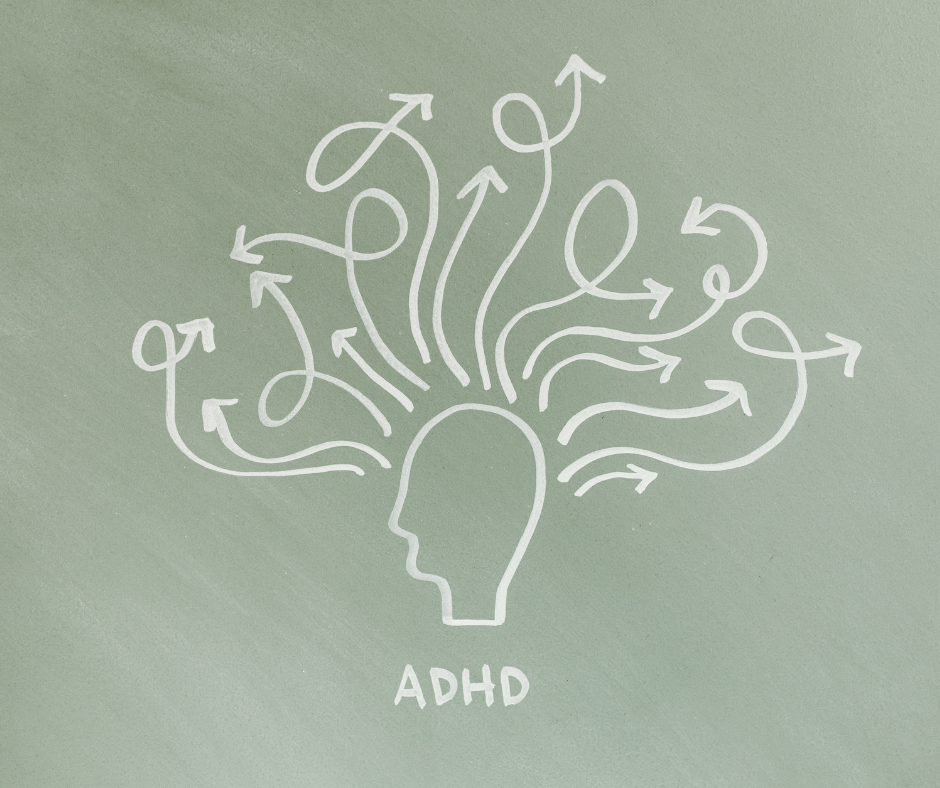
Think of ADHD as the inability to turn off stimuli. Most of us are able to block out information from our environment, and this keeps us from becoming overwhelmed. For example, if we are trying to concentrate on a book, we tend to block out sounds from music or television in the background. If we are trying to listen to a teacher’s lecture, we don’t pay attention to what we see outside through the window. We tend to focus on one line of thought at the time to keep ourselves from becoming confused and chaotic. The person with ADHD, on the other hand, cannot turn off these external stimuli, as well as most people (although they certainly block out most stimuli). Their lives become a struggle to filter out and manage the oversupply of information they have to deal with. What they are trying to do is to protect their sensitive inner selves. If the amount of information from their environment becomes overwhelming, they can become overstimulated. “Hyperactivity “is simply the response of the nervous system to an onslaught of stimulation.

Distorted Thoughts… Getting Back to Reality

*This newsletter is intended to offer information only and recognizes that individual issues may differ from those broad guidelines. Personal issues should be addressed  within a therapeutic context with a professional familiar with the details of the problem. Copyright 2016 Simmonds Publications: 550 La Jolla Blvd., 306, La Jolla, CA 92037

One of the best tools we have for living a healthy life is our ability to think. Our world is composed of a large number of events that happen constantly. Some are positive and some are negative, and most are neutral. We interpret these events as they happen with a series of thoughts that flow continually through our minds. This process is called our internal dialogue. We constantly think about present and past events, and sometimes about things that will happen in the future. And here’s the important point these thoughts need to be accurate. We need good reality testing in order to live effectively.

Our moods or feelings are created by the thoughts we have, and not by the actual events themselves. We need to think about events and attach a meaning to them before we experience an emotional response. People have different ways of interpreting the same event. Let’s say that our friend, Rhonda, has decided to move to a different part of the country. Some people will congratulate her for making a move that could bring her the happiness she has sought for a long time. Other people might condemn her for running away from the life she has here. Some will call her healthy. Some will call her greedy. Some will call her heartless. How we think about Rhonda will reflect our core beliefs about the world.


We define Rhonda’s actions in terms of how we personally interpret the world-and these interpretations reflect the basic assumptions we have about how the world works. Her move in itself signifies nothing until we think about it and place an interpretation or meaning on it. If we see it as a healthy move on her part, we can have a happy response. If we see her as being selfish, we might have an angry or depressed response to her move. Once we give meaning to an event, we can experience an emotional response to it. In other words, our thoughts can influence how we feel.

A Good Night’s Sleep

*This newsletter is intended to offer information only and recognizes that individual issues may differ from those broad guidelines. Personal issues should be addressed within a therapeutic context with a professional familiar with the details of the problem. Copyright 2018 Simmonds Publications: 550 La Jolla Blvd., 306, La Jolla, CA 92037

The National Sleep Foundation tells us that nearly half of us don’t get enough sleep. In modern-day society, because of night work, television, computers, and the profound stress we experience in everyday life, our sleep is often disrupted. Sleep is a basic biological need, like hunger and thirst. When we don’t get enough of it, our bodies let us know that there are consequences. Sleep is a regular, natural state of rest characterized by a reduction in voluntary body movement and a decreased awareness of the surroundings. Sleep is not a state of falling completely into unconsciousness, but rather an altered state of consciousness that performs a restorative function for the brain and body.

An older view of the function of sleep suggested that sleep is a period of rest from the activity of the day. It occurs at night when we would be safer by staying out of harm’s way. We know now, however, that sleep is much more than just a period of recuperation from the energy expended during the course of the day. A great deal happens during our sleep that is vital to maintaining our healthy.

When we sleep, the brain produces enzymes that neutralize the damage done to cells by molecules called free radicals (in other words, sleep keeps our bodies younger longer). This is just one of the many processes that happen during our sleep. One recent research study, for example, success that babies learn the placement of their own limbs during their sleep. As their arms and feet twitch during sleep, the brain maps out the positioning of their limbs and forms new neural connections. Adults use the same process to maintain existing connections in their nervous systems. Other research suggests that sleep may contribute to new nerve cells in the brain.

Making the Most of Our Life Transitions

*This newsletter is intended to offer information only and recognizes that individual issues may differ from those broad guidelines. Personal issues should be addressed within a therapeutic context with a professional familiar with the details of the problem. Copyright 2018 Simmonds Publications: 550 La Jolla Blvd., 306, La Jolla, CA 92037

There are times to let go of the old and embrace the new

Throughout the course of our lives we experience many endings and many beginnings. In nature we observe times when things move slowly without visible change- and then suddenly an acceleration occurs followed by a transformation. Daffodil shoots emerge from the cold ground, and then before we know it bloom in a dazzling array of perfumed beauty. Tree leaves which have been green all summer suddenly turn gold and within a short time are blown to the ground, the tree’s branches left bare. Transitions are as natural as night and day. And so it is with our lives.

Life transitions are predictable changes in our lives associated with a discontinuity with the past. With each change we must give up the protective structures which have carried us through and then face the world anew with a sense of fragility and vulnerability. These times of disruptions may force us to test the limits of our ability to adapt. However, with each transition we have the opportunity to learn a great deal about our inner coping resources and to ask ourselves what we really want out of life. This period of self-reflection can then lead to self-renewal and a new phase of stability and eventual equilibrium.

At times transitions are thrust upon us dramatically and unexpectedly. Disabling accidents, the deaths of those in our lives, divorce, the loss of a job, an illness- all of these events mean that we must leave something behind and then adjust to a new way of living, even if we feel totally unprepared to do so. These events can strike without warning and leave us in a personal crisis characterized by denial, anger, mourning and withdrawal. But not all transitions emerge from negative experiences. Marriage, a new job, a move to a new city, the birth of a child, reacquaintance with an old friend- these events which may be planned and expected can also lead us into the process of a life transition.


Why do we procrastinate?

*This newsletter is intended to offer information only and recognizes that individual issues may differ from those broad guidelines. Personal issues should be addressed within a therapeutic context with a professional familiar with the details of the problem. Copyright 2018 Simmonds Publications: 550 La Jolla Blvd., 306, La Jolla, CA 92037

Almost everyone has been afflicted by procrastination at one time or another, that nagging menace that compels us to put things off for another day, another time. For some people it is a persistent problem, and for others it appears in only some areas of their lives. The result, though, is the same for everyone, increasing anxiety, wasting time, poor performance, missed opportunities, guilt, excusing ourselves, and avoiding people who depend on us. There are better ways of dealing with the demands of our everyday lives. Procrastination is not a trivial problem; it causes suffering for many people.

Who is likely to procrastinate? There’s no research evidence that gender and intelligence have anything to do with a tendency to procrastinate. Age may have something to do with it. One research finds that procrastination peaks in the middle to late 20s, decreases for the next 40 years, and then increases again in the 60s. Other research finds that people who feel overwhelmed and cannot readily calm down tend to put tasks off. There is a relationship between anxiety and procrastination. It is no surprise that people who fear failure have this problem, as well as people with low self-esteem. People with poor tolerance for frustration, difficulty in delaying gratification, or people who cannot concentrate often find it difficult to stick with a task until it is completed. Research also shows that those who have conflicts with authority figures and are rebellious have a proclivity for procrastination. People with depression, who may have low energy and hold negative thoughts about their ability to get things done, frequently have problems with procrastination. And then there is the perfectionist. Those perfectionists who set their own standards seem to have no problem with “sloth,“ but those who have adopted the standard set by others do have trouble completing their work. This is because they are sensitive to the evaluations they might receive from others; they want to avoid social disapproval.

Procrastination is a serious problem for many people. It can undermine our sense of well-being and prevent us from experiencing the full potential of our lives. A portion of our time is spent pleasurably, and a portion is spent on tasks we may not particularly enjoy. Such is the nature of life. To avoid the disagreeable is, unfortunately, to compromise the pleasurable. The person who is emotionally healthy is one who is familiar with and can tolerate the ups and downs and highs and lows, the light and the dark. Living completely entails embracing our responsibilities, relishing our pleasures, and appreciating our time.

A few tips to overcome procrastination:

Make up a to do list. Write out a list of things you need to do this week, or day, or month, and then cross them off, one by one, when they are done. With this list, you can see exactly what needs to be accomplished, and you can get a feeling of fulfillment as a list gets whittled down. 

Set priorities. On your to do list, rank the jobs that need to be done in order of their importance. Then focus only on one job at a time. 

Celebrate the completion of your task. Have a specific reward in mind for when your project is finished. Go out for dinner. Go to a movie. Take a weekend trip. Have a party. The celebration should be equal to your task.

Look at all you have accomplished. Rather than punishing yourself for not having done enough, take the more positive approach of examining all that you have done. Is the glass half empty or half full? 

Finding intimacy

*This newsletter is intended to offer information only and recognizes that individual issues may differ from those broad guidelines. Personal issues should be addressed within a therapeutic context with a professional familiar with the details of the problem. Copyright 2018 Simmonds Publications: 550 La Jolla Blvd., 306, La Jolla, CA 92037

Many people search for that special intimacy in their relationship. Some of us search our entire lives for a feeling of oneness with another person. It’s hard to describe, really, what we search for, but we know it when we finally achieve it. Maybe we’re tired of that dark feeling of being ultimately alone as we struggle through life. If only there was someone else here, we say to ourselves, who could understand and share these burdens. Then it wouldn’t be so lonely. It wouldn’t be so hard. Or perhaps, in our more positive moments, we want to share, not just the burdens, but our pleasures too, our strength and beauty. We want the powerful impact of our internal experience to have an impression on someone else, as if to say that we count, we are whole, and we want to impart this feeling to another person.

Humans are social beings. Is that why we search for intimacy with others? Is a quest for intimacy the reason we commit ourselves to another person in marriage or some other public declaration of loyalty? In trying to find intimacy are we simply searching again for the ultimate feeling of bonding that we felt toward a parent during our infancy? The search for intimacy may be one reason we formed social groups, and it may explain why we request for spiritual fulfillment in our lives. 

Many people in contemporary society feel lonely. For all the benefits we derive from living in a highly technological world, seemingly instant and complete communication with others, we still may find it difficult to discover ways to form intimate relationships. In fact, our high-tech society seems to fragment our social connections, to drive us away from other people. For example, email seems to make connecting with other people much easier, but in truth or messages are usually just flashes of ideas, briefly written, briefly read, and instantaneously deleted, and they barely fulfill our desire for more complete relationships based on our inner experiences. In our modern society, we lack ways to see, hear, or touch other people, not in person, and not to the extent that humans have in the past. What our high-tech world has brought us is an abundance of stress. And stress and intimacy are hardly compatible bed fellows.

To form an intimate connection with another person requires first we have access to our own personal emotions and ideas. We cannot expect to be intimate with another when we are out of touch with our own internal experiences. Our intimate experiences may involve our emotional, cognitive, social, physical, sexual, and spiritual lives. Two people, each of whom is in touch with his or her own internal experiences, may be able to share an intimate relationship on any one of these levels. True intimacy is one of the ultimate expressions of the human experience. And that may be why we strive so hard to find it.

We must explore and become familiar with our own personal thoughts and feelings before we can share them with someone else. 


Finding Happiness

*This newsletter is intended to offer information only and recognizes that individual issues may differ from those broad guidelines. Personal issues should be addressed within a therapeutic context with a professional familiar with the details of the problem. Copyright 2018 Simmonds Publications: 550 La Jolla Blvd., 306, La Jolla, CA 92037

Most people seek a life filled with meaning, contentment, gratification, and pleasure. In moments of reflection, we may wonder what we can do to direct our lives not only away from anxiety, anger, stress and depression- but toward a state of personal fulfillment. We may realize that the typical markers of achievement in our society- a graduation, a marriage, a job promotion, the completion of a project, buying a home- don’t always bring us the happiness that we expected, and often they increase our stress levels.

Despite the fact that we are affluent by world standards, able to drive nice cars, live in large, clean houses, and have access to entertainment media, we are subjected to high levels of stress. As a result, many of us carry with us a pervasive feeling of discontent. We pursue the next highest goal in our lives, only to find that achieving that goal does not bring the feeling of true happiness that we long for. Most of us live better than royalty did in the past, but these high standards of living have not brought us a sense of true contentment. A survey of people in nations around the globe learned that the highest levels of personal happiness were found in Nigeria, followed by Mexico. The United States came in at number 16, while Canada and most of Western Europe also scored at similar levels.

Psychotherapy has made great strides over the past half century in understanding various forms of mental illness. We can now classify these conditions and make appropriate interventions to alleviate them though specific forms of psychotherapy and sometimes medication. Less research has been done, however in finding ways to understand how we can achieve a life filled with meaning and contentment.

We have a host of methods for treating some of the conditions associated with unhappiness- stress, anxiety, depression, anger, lack of engagement, substance abuse, poor interpersonal relationships, cognitive and emotional impairments. Now, however, psychotherapy is making similar strides in devising methods people can use to move to the next step, from unhappiness to true happiness.

The altruism option-a key to wellness in a fuller life

*This newsletter is intended to offer information only and recognizes that individual issues may differ from those broad guidelines. Personal issues should be addressed within a therapeutic context with a professional familiar with the details of the problem. Copyright 2018 Simmonds Publications: 550 La Jolla Blvd., 306, La Jolla, CA 92037

To few of us are in touch with a lifestyle choice that can bring us a wealth of happiness, integrity, and wellness. Altruism, or giving to others, has grown out of favor over the past several decades, but has been a feature of human interaction throughout history. Indeed, a history of cooperation and giving has always been a hallmark of what binds a group or even a society together. Two people sharing the resources can produce more than two individuals acting alone in most circumstances.

Many people take the attitude, why should they give anything to another person or organization? Over the past several decades our culture has seen his shift away from giving toward a focus on self-interest. This shift coincides with a weakening of our sense of community, the breakdown of the nuclear and extended family, higher divorce rates, increased emotional diagnoses for children, and increased stratification of the social and economic orders. Guided by self-interest and greed, rather than compassion and sharing, so society continue to grow wealthier will many others drift down into poverty. Over the past decades, people’s ties to each other have weakened, and more people feel lonely. Violence is increased as have human suffering in environment, destruction. More people these days feel disconnected from others and question whether their lives have meaning. They find security in acquiring material goods, the latest technological tool, the current handbag, the trendiest automobile. Heading to self-interest has not left us individually, or is a society, in an emotionally healthy state.

The antidote to this cultural trend is found at the individual level. When enough people become conscious of how little self-interest provides their lives and then challenges it by adopting a different way of living, it spreads throughout society. Recent research into neurological activity in the brain indicates that we are “hardwired” toward altruism, toward giving to others, compassion, caring, kindness, and sharing. This is the natural human condition. Exploring this part of yourself can bring you back into harmony with your natural state.
Of course, self-interest and altruism are not either/or concepts. We need both. Just as the person guided purely by self-interest loses a great deal in terms of life experiences, the completely altruistic person, constantly serving others, is deprived the experience of exploring aspects of his or her own self-care. The clue is to find a balance between these two extremes. At this cultural juncture, most people would benefit from looking into the altruistic options.

“Be the change you want to see in the world.” Ghandi